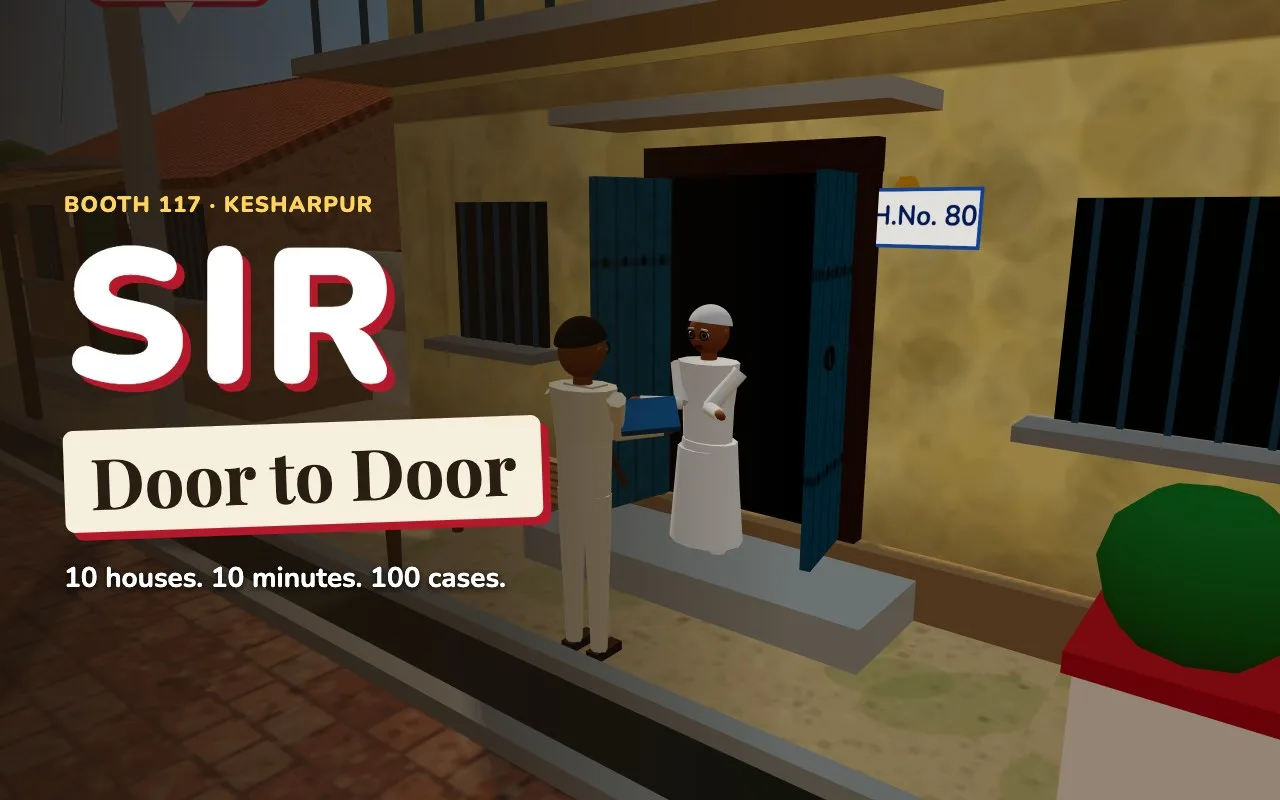
About SIR: Door to Door
SIR: Door to Door is a free 3D mystery game about the Special Intensive Revision of India's voter rolls. You are the Booth Level Officer (BLO) of a made-up village, Kesharpur: brick lanes, open drains, a peepal tree at the chowk, cows in the road, kids playing cricket. Ten houses are on your list and you have ten minutes.
At every house you knock, someone opens the door, you go in and sit on the plastic chair. Then it's up to you what you ask, and up to them what they tell you. Is Babuji really "in Haridwar"? Is Bunty really eighteen? Who on earth is the Rajkumar on your list? Check their papers with a magnifier, scan the Aadhaar QR, search the rolls on your phone, look at the garlanded photo on the wall, ask the neighbour over the wall.
Then decide every elector: form collected, dead, shifted, absent, duplicate, or refer to the ERO, link each one to the 2003 roll, and give Form 6 to new voters who are really eligible. There are 100 hand-written cases, so each shift is new. The rules follow the Election Commission's SIR 2026 guidance; the village, families and cases are made up.
How to play
- Walk to a house with a 📄 over the door (tap it, or use 🧭 Next house), then knock.
- Ask questions in 💬 Ask. Answers open new questions. Accepting the chai helps; pushy questions (⚠) can make a family stop talking.
- Pin facts: tap underlined words in what people say and lines on their papers. Two facts about one person that disagree become a finding.
- Investigate: tap the twinkling things in the room, open papers in 🪪 Papers (🔍 shows whitener, scan the QR), search the rolls, the 2003 roll and the death register in 📱 App, and ask the neighbour once.
- Decide in 📁 File: one decision per elector, the 2003 link for collected forms, Form 8 if a detail is wrong, Form 6 for eligible newcomers. Then submit and see the truth.
- Score comes from right decisions, evidence, speed and courtesy. Cutting a real voter costs the most.
Controls
| Click a lane or house | Walk there |
|---|---|
| W A S D | Walk |
| Drag / Q | Turn the camera |
| Wheel | Zoom |
| N | Next house |
| E or Space | Knock |
| 1 to 9 | Ask the question in that position |
| Space | Next line of dialogue |
| Esc / P | Pause |
| M | Mute |
| Phone | Tap to walk, drag to turn, pinch to zoom, tap buttons and words |
FAQ
What is SIR?
The Special Intensive Revision is the Election Commission of India's house to house check of the voter roll. Booth Level Officers bring every elector a pre-printed Enumeration Form, visit at least three times, link electors to the roll of the last SIR, and list those who are absent, shifted, dead or duplicates.
Do voters need documents during SIR?
Not during the enumeration phase, according to the Commission's guidance: no document has to be attached to the Enumeration Form. Electors who can't be linked to the last SIR roll may be asked for one of 12 documents later, in the notice phase.
Is this game accurate?
The rules (family can sign for someone working away, daughters-in-law link through their own parents, Form 6 for new voters, Form 8 for corrections, one entry per person) follow the Commission's SIR 2026 guidance as published by state CEOs. The village, people and cases are made up, and the documents are game props.
Will I see the same cases again?
Each shift deals ten cases you haven't seen yet from 100. The Case book on the menu shows which you have played.
Is it free?
Yes. It runs in your browser on computers and phones (in landscape), with nothing to install.
How do I get on the leaderboard?
Create a free account (18+). Your best shift score goes on the Best shift board.
A parody and fiction inspired by real events. Not news or advice, and not affiliated with or endorsed by anyone in the game. Legal & privacy