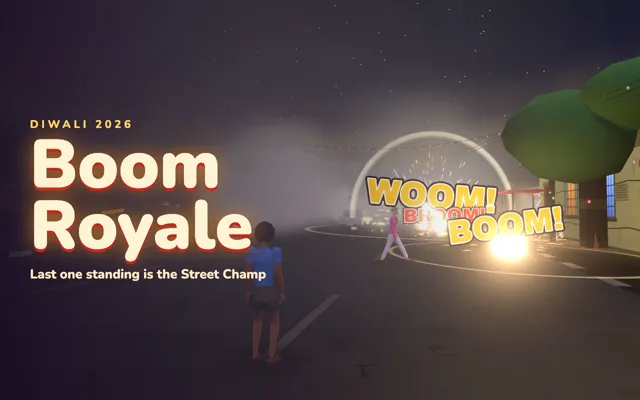
Delhi AQI hits 600 and GRAP III starts before Diwali: what it means, and a game to fight it
Delhi's AQI rose from 117 on 31 October 2026 to the "very poor" 360s and 380s by Diwali on 8 November, with a 605 reading on 4 November, and "severe" air is forecast for 9 November. CAQM brought in GRAP Stage III on 6 November, which stops most construction and keeps older petrol and diesel cars off the roads.
A week, from "moderate" to "please don't go outside"
On 30 October 2026, after rain from Cyclone Montha, Delhi's air quality index was 60. Satisfactory. On 31 October it was 117. Moderate. People went for walks. Someone probably said "maybe this winter will be different".
Then:
| Date | Delhi AQI | What it means |
|---|---|---|
| 31 October | 117 | Moderate |
| 1 November | 261 | Poor |
| 2 November | 324 | Very poor, GRAP Stage II starts |
| 3 November | 350 | Very poor |
| 4 November | 377, with a 605 reading in the morning | Very poor, 22 stations severe |
| 5 November | 369 | Very poor, 18 stations severe |
| 6 November | 382 | Very poor, GRAP Stage III starts |
| 7 November | 369 | Very poor |
| 8 November (Diwali) | 376 in the evening | Very poor, 19 stations severe |
The daily numbers are CPCB's citywide readings from its afternoon and evening bulletins. The 605 was a CPCB reading at 7:41 am on 4 November, reported by The Week. On Diwali morning, 24 of 54 stations reporting were above 400, with Jahangirpuri the worst at 450, The Week reported. By 7 pm the city average was 376.
The night before was no better. Diwali eve, at 369, was Delhi's most polluted in ten years, The Wire reported. And today, 9 November, the day after Diwali, the government's early warning system still says "severe". The day after is usually when the cracker smoke from the night before is still hanging around. CPCB's official number for today comes out in its afternoon bulletin.
So yes, it is that time of year again. Here is what is happening, and how you can try fixing it yourself in AQI 999, our free Delhi air game.
What is GRAP, and what does Stage III ban?
GRAP is the Graded Response Action Plan, Delhi-NCR's emergency rulebook for bad air. The Commission for Air Quality Management (CAQM) switches stages on as the AQI climbs:
| GRAP stage | AQI range | The idea |
|---|---|---|
| Stage I | 201 to 300 | Poor: dust control, no open burning |
| Stage II | 301 to 400 | Very poor: tighter rules on generators, parking and dust |
| Stage III | 401 to 450 | Severe: construction stops, old vehicles kept off roads |
| Stage IV | above 450 | Severe plus: trucks stopped, offices and schools go remote |
Stage II started on 2 November. Its headline rule is no diesel generator sets, except for emergency and essential services.
Stage III followed on 6 November, two days before Diwali, while the citywide AQI was still just under 400. That is new this year: since September 2026 CAQM can trigger stages from the forecast, and the forecast said "severe" for the Diwali weekend. According to The Week, Stage III means:
- No dusty construction. Construction and demolition that raises dust stops across NCR, including road building, major road repairs, drilling, piling and digging.
- Older cars stay home. BS-III petrol and BS-IV diesel four-wheelers are restricted in Delhi and the NCR districts named in the order.
- Hybrid classes. Since 7 November, Delhi schools run classes up to Class 5 in hybrid mode, so children can study online where that is possible, Outlook India reported.
All the Stage I and Stage II rules stay on top of that.
What else is in force right now?
A lot, actually. According to Outlook India and CAQM's winter plan:
- No BS-VI, no entry. From 1 November 2026 to 31 January 2027, non-BS-VI commercial vehicles from outside Delhi can't come in. BS-IV and older trucks and buses are barred from entering the city.
- No PUC, no fuel. Since May 2026, petrol pumps can refuse fuel to vehicles without a valid pollution certificate.
- Construction dust. On top of the Stage III stop, a full construction ban in Delhi is planned for 10 December to 20 January.
- Half the office stays home. Offices in Delhi, Gurugram, Faridabad, Sonipat, Ghaziabad and Gautam Buddh Nagar are limited to 50% attendance.
- Staggered office hours and higher parking fees to thin out rush-hour traffic.
- Anti-smog guns. Delhi's Public Works Department set up committees to inspect 200 truck-mounted anti-smog guns, each meant to clean at least 200 metres of road a day.
What about Diwali crackers?
Under the Supreme Court's order, only certified green crackers can be sold in Delhi-NCR, and they could be burst only from 6 am to 7 am and 8 pm to 10 pm on 7 and 8 November. The full ban came back today, 9 November.
The weather is not helping. The ventilation index, which measures how well the air can carry smoke away, was forecast to drop to about 2,500 on Diwali, well under the 6,000 that pollution scientists treat as the line for smoke to clear, Outlook India reported. Calm winds plus crackers plus farm smoke means the haze just sits there. The Early Warning System expected "severe" air from 7 to 9 November.
How much of this is stubble smoke?
Some days a lot, some days almost none. It depends on which way the wind blows.
The Decision Support System (DSS) that tracks Delhi's pollution sources put stubble burning's share of the city's PM2.5 like this, as reported by ThePrint, Business Today and Outlook India:
| Date | Stubble's share of Delhi's PM2.5 | Vehicles' share |
|---|---|---|
| 2 November | 8.6% (forecast) | |
| 3 November | 15.3% (forecast) | |
| 4 November | 20.2% | 15.5% |
| 5 November | 15.6% | 17.9% |
| 6 November | 19.2% (forecast) | 18.3% (forecast) |
| 7 November | 1.6% (forecast) | 21.1% (forecast) |
See 7 November? The wind changed, the stubble share was forecast to fall to almost nothing, and the AQI barely moved. Traffic, dust and Diwali stayed.
The number of farm fires is also far lower than a few years ago. Satellites counted 3,535 fires from 15 September to 2 November 2026, against 51,822 in the same stretch of 2020. By 4 November the season's count had reached about 4,800 across seven states, including 2,347 in Punjab and 62 in Haryana, with 467 on 4 November alone. Fires were still climbing into the Diwali weekend.
So why is the air still this bad? Because stubble was never the whole story. The environment ministry puts winter pollution at roughly 23% vehicles, 20% biomass burning and 27% secondary particles that form in the air itself. When the wind drops in November, all of it just sits over the city. Delhi's chief minister Rekha Gupta has also accused neighbouring states of letting fires start on purpose, so the smoke comes with a side of politics, as every year.
There is some good news hiding in the data: Delhi had 220 good air days up to 2 November 2026, compared with 200 by the same date last year.
Try it yourself: AQI 999
Reading about GRAP is one thing. Running it is another.
In AQI 999 you sit in Delhi's air command centre at ITO and look down on a 3D map of the city. The pollution comes from the same places it does in real life, and almost everything in the news above is a button you can press:
| In the news | In AQI 999 |
|---|---|
| GRAP stages | The GRAP dial in the control room moves with your city's AQI, using the same thresholds |
| BS-VI entry rule for trucks | The BS-VI Entry Rule policy and Border Check Posts at entry points like Singhu, Tikri and Ghazipur |
| No PUC, no fuel | The No PUC, No Fuel policy and ANPR Fuel Cameras at petrol pumps |
| GRAP III construction stop | C&D Portal 2.0, then the full Construction Ban (it costs you money and mood) |
| 50% office attendance | The 50% Work From Home policy |
| Staggered hours, parking fees | Staggered Office Hours and Double Parking Fees |
| Anti-smog guns | Anti-Smog Guns, Smog Gun Trucks and Mist Spray Poles |
| Stubble fires in Punjab and Haryana | Stubble fire incidents, Happy Seeders, Bio-Decomposer Hubs and Satellite Fire Alerts |
| Landfills at Ghazipur, Bhalswa, Okhla | All three are on the map, and Biomining Units shrink them |
The catch is the same one the government has. Every rule costs money, and the strict ones make people unhappy. Switch on Odd-Even and the Construction Ban on day one and the city's mood crashes before the AQI does. You also can't ban your way out of it: the wind still blows stubble smoke in from the borders every November.
Our tip for this week: watch the wind compass. When it swings to the north-west, stubble smoke is on the way. Send your Happy Seeders to the stubble fires and build a Bio-Decomposer Hub at the farms before the smoke reaches ITO. When the wind drops, it is the city's own traffic and dust that pile up, so that is the moment for the traffic policies.
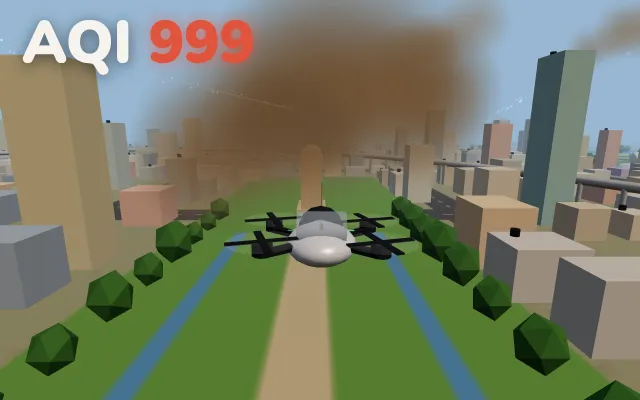 Free browser gameAQI 999Run Delhi's air from the command centre at ITO: put out garbage fires, seal smoking factories, clear the ITO jam, build monitors, smog towers and e-bus depots, flip the policy switches and bring the AQI down over India Gate.▶ Play free
If you are new to the game, the AQI 999 guide covers what to build first, and the launch post explains how the city works.
How to protect yourself while the AQI is this high
The game is free and safe to play from your sofa. The real air is not. On days like these:
- Check the AQI before going out and avoid exercise outdoors when it is above 300.
- If you wear a mask, an N95 that fits properly helps. Cloth masks don't do much against PM2.5.
- Keep windows shut during the worst hours, usually early morning and late evening. On Diwali night, that means after 8 pm.
- Children, older people and anyone with asthma or heart conditions should be extra careful, and talk to a doctor if breathing gets hard.
Frequently asked questions
What is Delhi's AQI today?
It changes by the hour, so check CPCB's Sameer app or a live tracker. On Diwali, 8 November 2026, the citywide AQI was 376 at 7 pm, and 19 of 59 stations were in the "severe" band. For 9 November, the day after Diwali, the forecast is "severe". On 4 November a morning reading touched 605.
When did GRAP Stage III start in November 2026?
CAQM invoked GRAP Stage III across Delhi-NCR on 6 November 2026, two days before Diwali, because the forecast showed "severe" air for the weekend. Stage II had started on 2 November, after the AQI reached 324.
What is banned under GRAP Stage III?
Dust-raising construction and demolition across NCR, including road building, drilling, piling and digging, and BS-III petrol and BS-IV diesel four-wheelers in Delhi and named NCR districts. Delhi schools run classes up to Class 5 in hybrid mode. The Stage II ban on diesel generators, except for emergency and essential services, also stays.
Can you burst crackers in Delhi now?
No. Under the Supreme Court's order, certified green crackers were allowed only from 6 am to 7 am and 8 pm to 10 pm on 7 and 8 November 2026. The full ban came back on 9 November.
How much of Delhi's pollution is from stubble burning?
It changes every day with the wind. The government's Decision Support System put stubble's share of Delhi's PM2.5 at 20.2% on 4 November 2026 and 15.6% on 5 November, and forecast just 1.6% for 7 November when the wind changed. Vehicles, dust and secondary particles keep the air bad either way.
Is there a game about Delhi's air pollution?
Yes. AQI 999 is a free browser game on bumshi where you run Delhi's air command centre: you put out fires, enforce policies like the BS-VI entry rule and GRAP construction bans, build smog towers and e-bus depots, and try to get the city's AQI under 100.