Hormuz Standoff guide: controls, escalation and 3 stars
To do well in Hormuz Standoff, keep the escalation meter low: hail, warn and fire a warning shot before you shoot, stay out of the other side's waters, and use the de-escalate radio call when tension rises. Win the main objective for one star and complete bonus objectives for the second and third.
What is Hormuz Standoff?
Hormuz Standoff is a free 3D naval strategy game set in a fictional crisis in the Strait of Hormuz. You play three campaigns of five missions (an unarmed merchant ship, a US Navy destroyer and an Iranian fast attack boat) plus Convoy Endless, a wave mode with a leaderboard. It runs in the browser on computers and phones. If you want the real-world background first, read the Strait of Hormuz explained.
Controls
| Key | What it does |
|---|---|
| W / S | Engine telegraph one step up or down |
| A / D | Rudder (it stays where you leave it; X centres it) |
| V | Change view: bridge, chase camera, tactical map |
| Tab | Select the next contact |
| 1 to 9 | Pick a weapon or system |
| Space | Fire (hold for the machine gun) |
| R | Radio menu |
| G | Damage control |
| T | Time compression (only when no contact is close) |
| ? or F1 | Show or hide the on-screen controls guide |
On a phone, turn it sideways and use the on-screen telegraph, rudder, fire, target, radio and view buttons.
How does the escalation meter work?
The escalation meter is the heart of the game. It runs from 0 to 100, and at 100 the ceasefire collapses and the mission is lost. It rises when you:
- Fire without warning. Unprovoked fire is the biggest jump. Firing after a hail and a warning but before a warning shot is smaller, and firing at a ship that keeps closing after all three steps is smaller still.
- Hit a civilian ship. Each one adds a lot and costs points at the end.
- Skip steps on the ladder. A warning without a hail, or a warning shot without a warning, adds a little.
- Go where you shouldn't. As the merchant or the US destroyer, sailing into Iranian territorial waters raises it every second. As the Iranian boat, crowding a US warship does the same.
It falls on its own after a few quiet seconds. The radio's de-escalate call (on the merchant, "peaceful transit, no weapons aboard") knocks a big chunk off at once, then needs 30 seconds to be ready again.
The warning ladder: hail, warn, warning shot
Open the radio with R and select a contact with Tab:
- Hail asks them to identify themselves.
- Warn tells them to alter course. Many will comply.
- Warning shot fires across their bow. After this, firing is justified if they keep closing.
A ship that fires at you, or at someone you're protecting, turns hostile and you can engage it freely. Identify before you shoot: contacts start as unknown, and some fishing boats really are fishing boats. Close in, use the binoculars (Z) from the bridge, or send the helicopter as the destroyer.
How are stars and scores worked out?
Winning the main objective gives one star. Each bonus objective you complete adds one more, up to three. A mission unlocks once the one before it has at least one star.
Your score adds up:
- objectives (primary ones are worth more than bonus ones)
- the condition of your hull
- a speed bonus for every second under the mission's par time
- threats stopped: missiles intercepted, hostiles disabled, missiles decoyed
- survivors rescued
Then it takes off a restraint penalty based on the highest escalation you reached and any civilian ships you hit. That's why a calm, clean win often beats a fast, violent one. Easy scores ×0.8 and Hard scores ×1.25.
Tips for each side
Merchant: MV Saraswati Star
- Big ships take a long time to stop and turn. Make small rudder changes early, and slow down with the telegraph well before you need to.
- Stay inside your traffic lane. Some bonus objectives depend on it.
- Use the radio. MAYDAY, PAN-PAN and SECURITE calls bring help, and going dark (AIS off) hides you but also hides you from your own escort.
- Keep the fire hoses ready when boarders approach and press G for damage control when you're burning.
US Navy: USS Winslow Reed
- Let auto-intercept (K) handle incoming missiles while you manage the picture, and keep the close-in gun for leakers.
- Decoys and turning away save you from torpedoes and missiles you can't stop.
- Some missions give a bonus for using few interceptors, so don't fire two at every track.
- Stay south of the Iranian territorial line unless the mission sends you north.
Iran: fast boat Tondar 14
- You're quick but fragile. Use speed to choose the angle, and don't trade fire with a destroyer head-on.
- Order stops and inspections on merchants rather than shooting.
- Keep your distance from US warships: crowding them raises escalation quickly.
- Your wingmen follow your orders. Some missions give a bonus for losing none.
Convoy Endless tips
Convoy Endless sends wave after wave of threats at a merchant convoy you escort as the destroyer. Each wave survived adds a bonus. Keep the destroyer between the threat axis and the merchants, save time compression for the quiet between waves, and remember that a merchant lost hurts more than a missile spent. Log in to put your best run on the leaderboard.
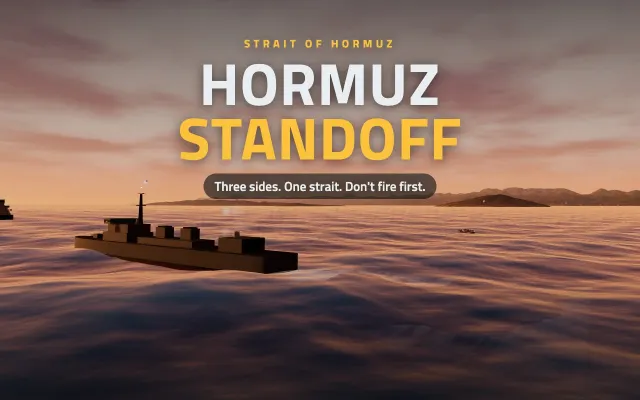 Free browser gameHormuz StandoffA 3D naval standoff told from three decks: a merchant captain, a US destroyer and an Iranian fast boat. Warn, bluff, intercept missiles and keep it from becoming a war.▶ Play free
Frequently asked questions
Which Hormuz Standoff campaign should I start with?
The merchant campaign. It teaches ship handling and the radio without weapons. The US campaign is about air defence and rules of engagement, and the Iranian campaign is fast and close-range.
Why did my mission end when I fired?
The escalation meter reached 100. Firing on a ship that hadn't shown hostile intent adds a lot of escalation at once. Hail, warn and fire a warning shot first, or wait until the ship fires.
How do I change the difficulty?
Pick Easy, Medium or Hard in the settings or with the button on the mission briefing. Medium is the default. Harder settings make enemies hit harder and more often and give a higher score.
Is Hormuz Standoff based on real events?
It's inspired by reporting on shipping in the Strait of Hormuz, but the story, ships, people and companies are fictional and the game doesn't take a side.