The Strait of Hormuz, explained: why it matters for oil
The Strait of Hormuz is the narrow sea passage between Iran and Oman that links the Persian Gulf to the open ocean. Before 2026 about 20 million barrels of oil a day, roughly a fifth of world consumption, passed through it. Since Iran declared it closed in March 2026, traffic has fallen by about 95%.
Where is the Strait of Hormuz?
The Strait of Hormuz sits between Iran to the north and the Musandam peninsula of Oman to the south. It is the only sea route out of the Persian Gulf, so every tanker loading oil in Kuwait, Iraq, Qatar, Bahrain, most of Saudi Arabia's Gulf coast, the UAE's Gulf ports and Iran itself has to pass through it to reach the rest of the world.
At its narrowest the strait is about 33 kilometres (21 miles) across, and big ships use a traffic separation scheme: one inbound lane and one outbound lane, each about 3 kilometres (2 miles) wide, with a buffer zone of the same width between them. Islands such as Qeshm, Hormuz, Larak and the Tunbs sit along the northern side.
How much oil goes through the Strait of Hormuz?
According to the US Energy Information Administration (EIA, June 2025), in 2024:
- About 20 million barrels a day of oil flowed through the strait, around 20% of global petroleum liquids consumption.
- That was more than a quarter of all oil traded by sea.
- About a fifth of the world's liquefied natural gas (LNG) trade also passed through, mostly from Qatar.
- 84% of the crude and 83% of the LNG went to Asia. China, India, Japan and South Korea together took 69% of the crude heading to Asian markets.
Can oil avoid the strait?
Only some of it. Saudi Arabia's East-West pipeline can carry crude across the country to the Red Sea, and the UAE has a pipeline to the port of Fujairah, outside the strait. The EIA estimates that only about 2.6 million barrels a day of spare pipeline capacity could bypass Hormuz in a disruption, a small slice of normal flows. Qatar's LNG has no bypass at all.
What happened to Hormuz shipping in 2026?
The strait has been at the centre of the 2026 conflict involving Iran. Based on Al Jazeera's reporting (27 August 2026):
| Date (2026) | What happened |
|---|---|
| 28 February | US and Israeli strikes on Iran begin the war |
| 2 March | Iran's Revolutionary Guard announces the strait is closed; traffic falls to about five ships a day |
| 17 June | An interim agreement lifts traffic to about 20 ships a day, roughly a fifth of normal |
| 14 July | The US resumes its blockade and traffic drops back to about five a day |
| Mid July to late August | Traffic averages about five vessels a day, nearly 95% below pre-war levels |
Before the war about 100 ships a day passed through, more than half of them tankers. Oil prices peaked above $130 a barrel in April and were still about 20% above pre-war levels in late August, according to the same report.
As of early October 2026, the picture had not changed much. The IMF's PortWatch tracker showed commercial transits on 4 October at about 5% of the pre-crisis count, and attacks on tankers were still being reported. Figures from different trackers vary, so check the latest data before relying on any single number.
Why does a narrow strait move fuel prices everywhere?
Oil is priced on a global market. When a fifth of supply can't move, buyers compete for the barrels that can, and prices rise for everyone, including countries that buy no Gulf oil at all. The effect is stronger for countries that depend heavily on the Gulf: Al Jazeera cites Pakistan (78%) and Japan (77%) among them. Shipping costs, war-risk insurance and delays add to the bill, and they show up later in the price of petrol, diesel, cooking gas and plastics.
Why is it so hard to keep the strait open?
Because it's narrow, crowded and close to shore. Ships in the lanes are within reach of coastal missiles, drones, mines and small fast boats, and a single damaged tanker can block traffic for hours. Navies escorting convoys face a constant judgement call: an approaching boat could be a fisherman, a smuggler or an attacker, and firing at the wrong one could start a wider war. That dilemma is the core of our game.
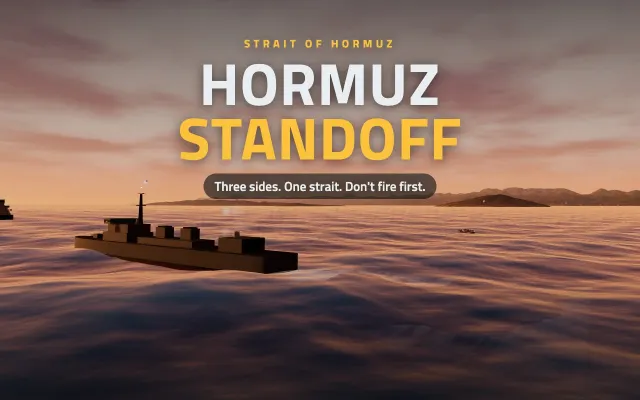 Free browser gameHormuz StandoffA 3D naval standoff told from three decks: a merchant captain, a US destroyer and an Iranian fast boat. Warn, bluff, intercept missiles and keep it from becoming a war.▶ Play free
Hormuz Standoff lets you play that judgement call from three decks: an unarmed merchant captain, a US destroyer commander and an Iranian fast boat. The story and the ships in the game are fictional; it is inspired by the reporting above but doesn't depict real events or take a side. Read our Hormuz Standoff guide for tips.
Frequently asked questions
Which countries border the Strait of Hormuz?
Iran on the northern side and Oman, through its Musandam peninsula, on the southern side. The United Arab Emirates lies just to the south-west.
How wide is the Strait of Hormuz?
About 33 kilometres (21 miles) at its narrowest point. The shipping lanes inside it are much narrower, roughly 3 kilometres each.
What percentage of the world's oil passes through the Strait of Hormuz?
In 2024, about 20% of global oil consumption and more than a quarter of seaborne oil trade, according to the US Energy Information Administration.
Is the Strait of Hormuz closed?
Iran declared it closed in March 2026. Since then traffic has run at roughly 5% of normal for most of the year, with a brief rise to about a fifth of normal after an interim deal in June. Some ships still cross, so "closed" in practice means severely restricted.